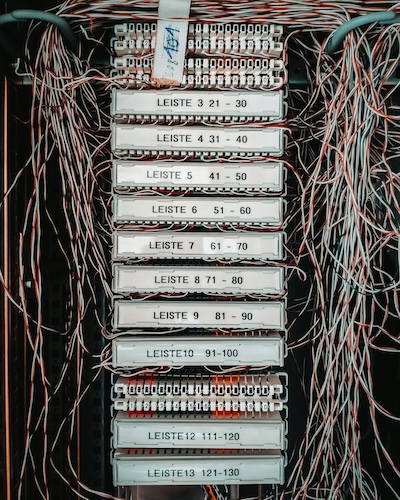
On 31 January 2027, the UK’s traditional copper telephone network — the Public Switched Telephone Network (PSTN) — permanently switches off. After that date, every analogue phone line in the country simply stops working. If your business still relies on a traditional landline, the clock is ticking — and doing nothing is not a safe option.
Despite years of warnings, over 500,000 business lines still haven’t migrated as of early 2026. Many business owners assume their provider will sort everything out automatically. Some don’t even know the switch-off is happening. This guide explains exactly what changes, what you risk losing, and how to protect your business phone number and service before the deadline hits.
The Deadline Is Real — and It’s Not Moving
The PSTN switch-off has been in the works for years. BT’s network division, Openreach, stopped selling new PSTN lines back in 2023 and has been systematically closing exchanges ever since. The final shutdown date — 31 January 2027 — is fixed. There will be no extension.
To force the remaining holdouts off the old network, Openreach is hiking legacy line prices aggressively through 2026: a 20% increase in April, followed by 40% in July, and another 40% in October. By the time the network switches off, businesses still clinging to analogue lines will be paying vastly inflated prices for a service that’s about to disappear entirely.
This isn’t a gradual wind-down. On 1 February 2027, traditional analogue lines will carry no dial tone. Any business that hasn’t moved to an alternative will have no incoming or outgoing calls — and no guarantee of recovering their number after the fact.
What Actually Stops Working
The switch-off affects far more than just the phone on your desk. The PSTN underpins a surprisingly wide range of business-critical equipment. Around 1.5 million UK businesses rely on PSTN-connected devices that go beyond a simple telephone handset.
| Equipment | PSTN Dependent? | Action Required |
|---|---|---|
| Analogue desk phones | Yes — stops working | Replace with VoIP or virtual number |
| Fax machines | Yes — stops working | Switch to online fax or email |
| Burglar alarms | Often — check with provider | Upgrade to IP or mobile-connected alarm |
| Door entry systems | Often — check with provider | Upgrade to SIP or mobile-based entry |
| Lift emergency phones | Yes — 12,000+ still need upgrading | Upgrade to GSM or VoIP lift phone |
| EPOS / card terminals | Some older models | Check with payment provider |
| CCTV monitoring | If using dial-up connection | Switch to IP-based monitoring |
| ADSL broadband | Yes — runs over the copper line | Migrate to fibre or alternative broadband |
If your broadband is delivered via ADSL — which still runs over the copper telephone line — that will stop working too. You’ll need to move to fibre, cable, or another broadband technology before the deadline. For businesses in areas without full-fibre coverage, this adds another layer of urgency to planning the transition.
Don’t just think about your phone. Walk through your premises and identify every device connected to a phone socket. Alarm panels, door buzzers, payment terminals, and CCTV systems are easy to overlook until they suddenly stop working.
What Happens to Your Phone Number
For most businesses, the phone number is the real asset. It’s printed on vans, listed in directories, saved in customers’ phones, and embedded across years of marketing. Losing it means losing a direct line to every customer who already knows how to reach you.
The good news is that phone numbers can be kept — but only if you act before the switch-off. Through a process called number porting, your existing business number can be transferred to a new provider and continue working exactly as before. Customers dial the same number; calls simply arrive via the internet instead of a copper wire.
The bad news is that porting takes time. It requires coordination between your old provider and your new one, and there are administrative steps that can take days or weeks. Leaving it until the last minute — or worse, leaving it until after the network goes dark — risks the number falling into a dead pool where recovery becomes difficult or impossible.
Start the porting process well before January 2027. Once the PSTN switches off and your line goes dead, recovering a number that wasn’t ported in time becomes far harder. With Virtually Local, porting is free and we handle the entire process for you.
What Your Current Provider Is (and Isn’t) Doing
Some providers, including BT, have stated they’ll auto-migrate customers to their own digital replacement services before the deadline. BT’s offering is called Digital Voice — a VoIP service that routes calls through your broadband router instead of a copper line.
On the surface, that sounds straightforward. In practice, there are significant catches that many businesses aren’t aware of.
-
No guarantee you keep your number Auto-migration doesn’t always mean your number transfers seamlessly. Some businesses have reported losing their number during the process or being told it can’t be migrated to the new platform.
-
Power dependency Digital Voice requires mains power and a working broadband connection. Traditional landlines worked during power cuts — VoIP through a router does not, unless you add a battery backup.
-
You may not get a good deal Auto-migrated customers often end up on whatever tariff the provider defaults them to — not necessarily the cheapest or most suitable. You lose the leverage of actively choosing a provider on your own terms.
-
Device compatibility issues Digital Voice may not support alarm systems, fax machines, or other non-voice devices that currently use your phone line. You could find your alarm stops dialling out even though your phone still works.
Relying on your provider to sort everything out is a gamble. The safest approach is to take control of the migration yourself, choose a service that genuinely fits your business, and port your number on your own timeline.
The Hidden Costs of Waiting
Even if you plan to migrate eventually, delaying is already costing you money. Openreach’s aggressive price increases through 2026 mean that every month you stay on a legacy line, you’re paying more for less.
| Date | Openreach Price Increase | Cumulative Impact |
|---|---|---|
| April 2026 | +20% | Line rental starts climbing sharply |
| July 2026 | +40% | Costs now significantly above alternatives |
| October 2026 | +40% | Legacy lines become prohibitively expensive |
| January 2027 | Service ends | Line stops working entirely |
These increases are deliberate — designed to make staying on the old network so expensive that migration becomes the only rational choice. The irony is that many businesses will pay months of inflated charges before finally switching, when they could have moved to a cheaper, better solution today.
Every month you delay switching is a month of unnecessarily high line rental. A virtual number from Virtually Local starts at just £4.95 per month — a fraction of what you’re paying for a copper line that’s about to be switched off.
Audit Your Equipment Now
Before you migrate anything, you need to understand exactly what your business has connected to the PSTN. Many business owners think the switch-off only affects their phone — and then discover their alarm, door entry, or payment terminal has stopped working too.
Check Every Phone Socket
Trace every device plugged into a BT-style phone socket on your premises. This includes phones, fax machines, franking machines, and any adapters feeding other equipment.
Contact Your Alarm Company
Ask whether your intruder alarm or fire alarm uses a phone line to communicate with the monitoring centre. If it does, it needs upgrading to a cellular or IP-based communicator before the switch-off.
Check Your Broadband Type
If your broadband arrives via ADSL (over the phone line), it will stop working when the PSTN switches off. Contact your broadband provider about migrating to fibre or an alternative connection.
Review Payment Terminals
Older EPOS and card machines that dial out over a phone line will need replacing with IP or mobile-connected terminals. Your payment processor can advise on compatible hardware.
Tackling this audit now gives you time to plan, budget, and schedule upgrades without the panic of a looming deadline. Leaving it until late 2026 means competing with hundreds of thousands of other businesses scrambling for the same engineers and equipment.
You Probably Don’t Need What They’re Selling
Here’s what many businesses aren’t being told: the switch-off is being used as an opportunity to upsell. Telecoms providers and IT companies are pushing hosted PBX systems, multi-handset VoIP setups, and expensive contracts to businesses that simply don’t need them.
If you’re a sole trader, a small team, or a business that primarily needs customers to be able to call you — you don’t need a full phone system. You need a phone number that works reliably and forwards calls to your mobile.
| Solution | Typical Cost | Best For |
|---|---|---|
| Hosted PBX system | £15–£30+ per user/month | Offices with multiple extensions and receptionists |
| VoIP desk phone setup | £100–£300 hardware + monthly fees | Businesses that need physical handsets at desks |
| BT Digital Voice | Included with BT broadband packages | Residential or businesses already on BT broadband |
| Virtual number | From £4.95/month | Sole traders, small teams, mobile businesses, anyone who answers on a mobile |
A virtual phone number gives you a proper local or national business number that forwards to your mobile, with professional features like voicemail to email, time-of-day routing, and call recording — without the complexity or cost of a full phone system. There’s no hardware, no broadband dependency for receiving calls, and no engineer visit required.
If your current setup is a landline that rings and you answer it — or it goes to voicemail — then a virtual number does exactly the same job for a fraction of the price, with better features. Don’t let anyone sell you a system you don’t need. Read more about whether your business really needs more than a smart virtual number.
Why Virtual Numbers Are Already Future-Proof
Unlike BT Digital Voice or traditional VoIP desk phones, virtual numbers have no dependency on copper infrastructure whatsoever. They work over the internet — which means the PSTN switch-off doesn’t affect them at all. If you’re already using a virtual number from Virtually Local, you have nothing to worry about.
-
No copper, no problem Virtual numbers route calls over the internet. The copper network shutting down has zero impact on your service.
-
Works on any phone Calls forward to your mobile, a colleague’s phone, or multiple phones simultaneously. No special hardware or handsets needed.
-
Full control online Manage your number, routing rules, voicemail, and call settings from the Virtually Local online portal — anywhere, any time.
-
Port your existing number Bring your current business number with you through free number porting. Your customers won’t notice any change — calls just keep coming through.
Virtual numbers aren’t a stopgap solution for the switch-off — they’re the long-term replacement. No copper dependency, no hardware to maintain, no line rental, and a feature set that grows with your business.
How to Switch Before the Deadline
Moving your business phone to a virtual number takes minutes, not weeks. Here’s how to make the transition smoothly and keep your existing number.
Get a Virtual Number Now
Choose a local area code that matches your business location, or pick a number for each area you serve. Your new number is active immediately — you can start using it straight away while your existing number is being ported.
Port Your Existing Number
Request a free number port to transfer your current business number to Virtually Local. We handle the process with your old provider — you just need to authorise the transfer.
Set Up Your Call Routing
Configure where calls go: your mobile, a colleague, or multiple destinations. Set up time-of-day routing for after-hours handling and enable voicemail to email so you never miss a message.
Cancel Your Old Line
Once your number has ported and everything is working, cancel your legacy PSTN line and stop paying inflated line rental. You’ll save money from day one.
Don’t wait for the October 2026 price hike to force your hand. The earlier you switch, the more you save — and the more time you have to iron out any details with porting or call routing.
The Bottom Line
The PSTN switch-off on 31 January 2027 isn’t a vague future event — it’s less than a year away. Over half a million business lines still need to migrate, Openreach is deliberately making legacy lines more expensive every quarter, and businesses that do nothing risk losing both their phone service and their number.
The good news is that migrating doesn’t have to be complicated or expensive. For the majority of small businesses, a virtual phone number is the simplest, cheapest, and most future-proof replacement for a traditional landline. No hardware, no engineer visits, no long contracts — just a professional business number that forwards to your mobile with features that a copper line could never offer.
If you haven’t already read our companion guides, they cover the switch-off in more detail: The UK PSTN Switch-Off Explained for Small Businesses and How to Replace Your Business Landline Before the Copper Network Closes.
The PSTN is switching off on 31 January 2027 and your traditional phone line will stop working. Don’t wait for your provider to auto-migrate you onto a deal you didn’t choose. Take control now: port your number for free, get a virtual number from £4.95 per month, and move on from copper before it moves on from you.
Ready to Get Your Local Business Number?
Choose from hundreds of UK area codes and start receiving calls in minutes.
Browse Area Codes